

Artificial intelligence is no longer a future-focused innovation that businesses can afford to observe from the sidelines. Today, AI is actively reshaping how organizations operate, compete, and grow. According to McKinsey’s 2025 Global AI Survey, 88% of organizations now use AI in at least one business function, driving automation, decision-making, and customer engagement across industries.
However, while AI adoption accelerates rapidly, many organizations still struggle to create measurable business value. McKinsey reports that only 39% see any enterprise-level EBIT impact, most below 5%. Gartner projects global AI spending to reach $2.5 trillion in 2026. In most cases, the challenge is not the technology itself, but lack of strategic alignment, governance, workforce readiness, and leadership direction. As a result, AI initiatives often become fragmented and difficult to scale.
This is where AI advisory becomes critical.
AI advisory helps leadership teams move beyond experimentation and build a structured approach to AI transformation. Rather than focusing only on implementation, AI advisory aligns AI initiatives with business goals, operational priorities, and long-term growth strategies. Consequently, organizations can adopt AI more responsibly, scale more effectively, and generate stronger business outcomes.
What Is AI Advisory?
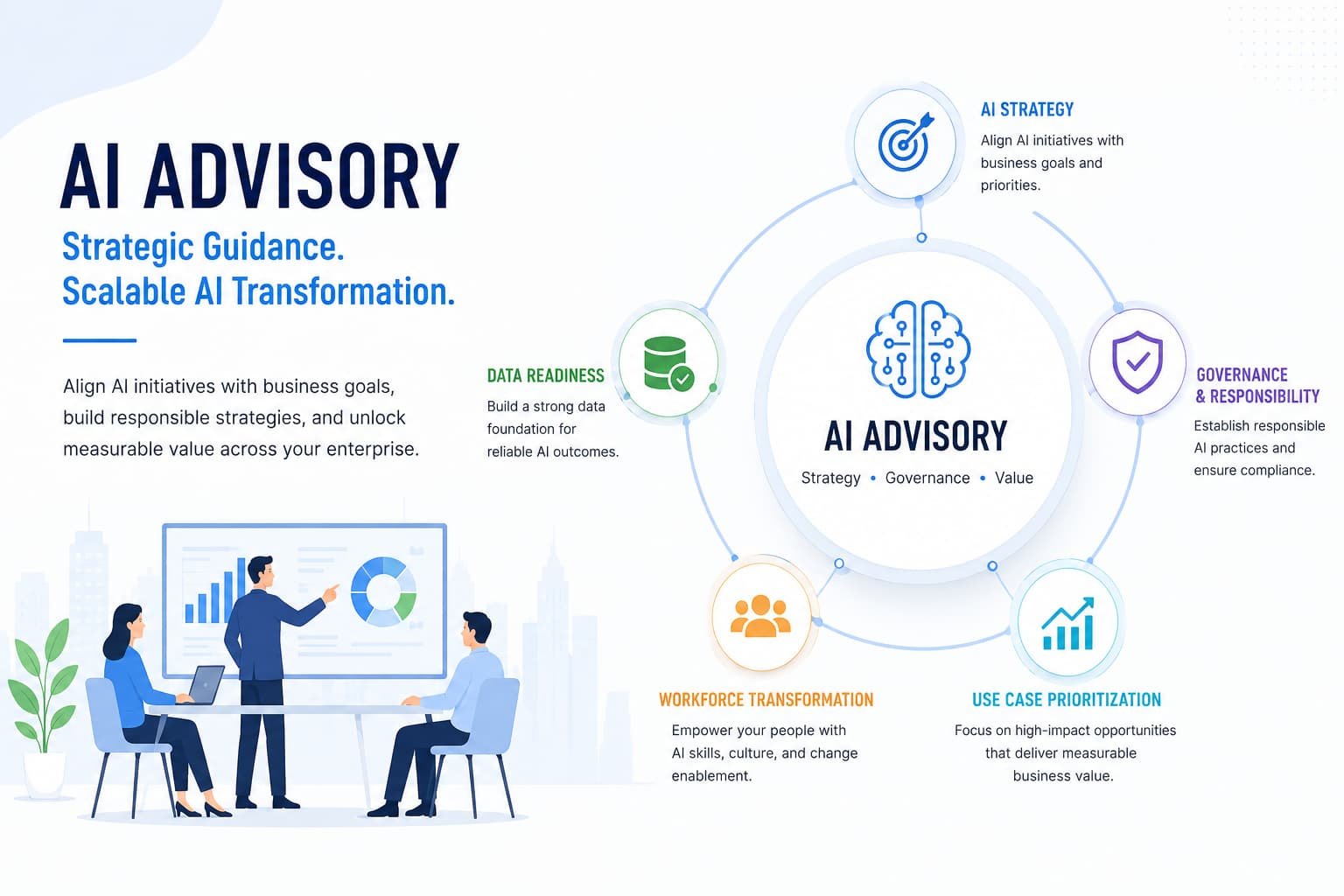
AI advisory is a strategic consulting approach that helps organizations adopt, manage, and scale AI effectively. Unlike traditional IT consulting, it prioritizes business transformation over technology. The goal is to deliver measurable business outcomes. According to McKinsey’s 2025 Global AI Survey, organizations with strong AI strategies are 2.5 times more likely to report significant financial impact.
Key areas covered under AI advisory include:
- Enterprise AI Strategy: Building AI roadmaps aligned with long-term business goals and operational priorities.
- AI Governance and Compliance: Establishing frameworks for security, transparency, compliance, and responsible AI adoption.
- Data Readiness: Strengthening infrastructure, data quality, and integration capabilities to support scalable AI systems.
- Workforce Transformation: Preparing employees through AI literacy, reskilling, and organizational change management.
- AI Investment Prioritization: Identifying high-value AI initiatives that deliver measurable ROI and operational impact.
- Responsible AI Practices: Reducing risks related to bias, privacy, explainability, and ethical AI usage.
Without a strategic advisory approach, organizations often struggle with fragmented adoption and unclear transformation outcomes. Therefore, AI advisory provides the structure businesses need to scale AI with confidence.
Why Leadership Needs AI Advisory?
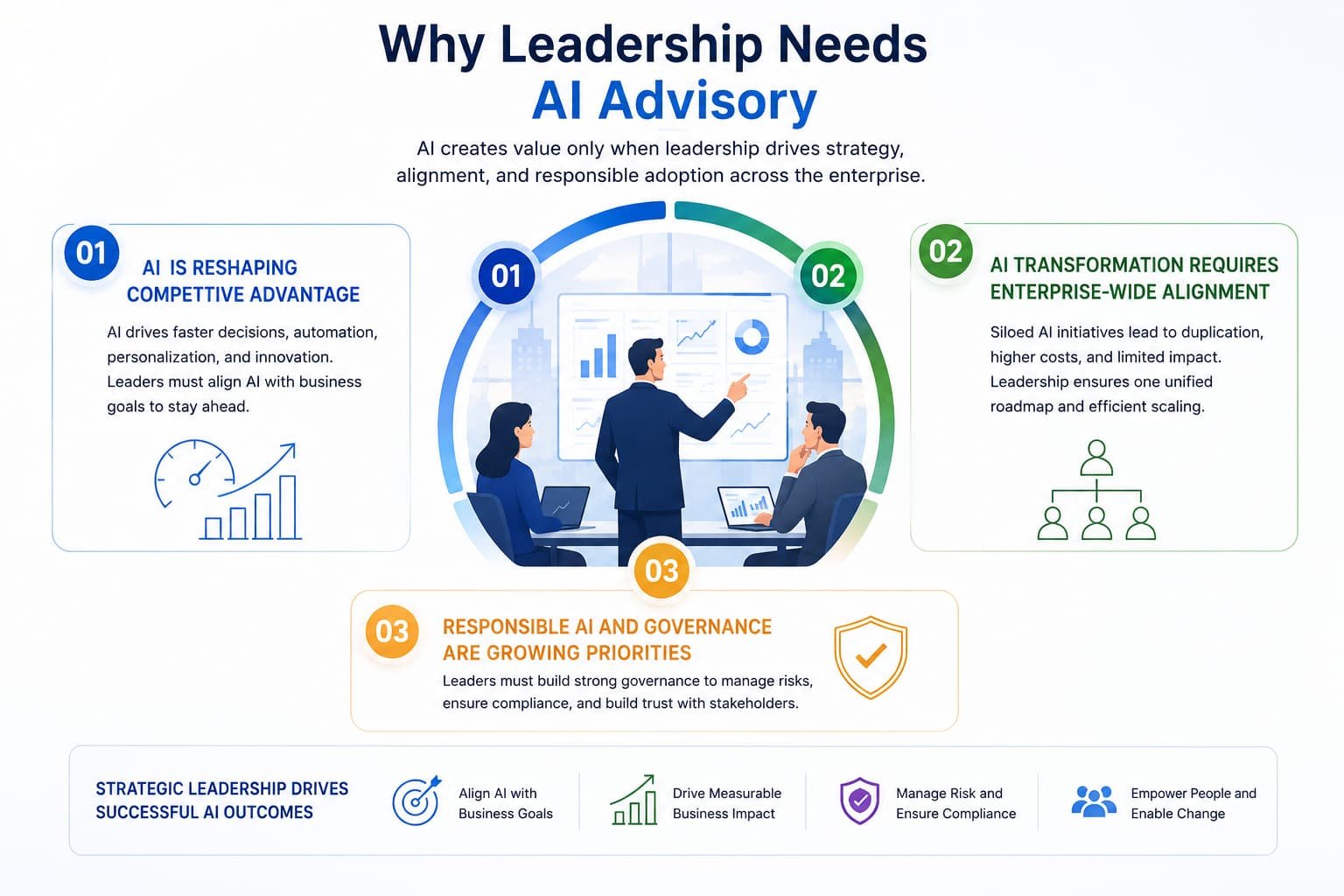
Why leadership alignment matters in AI transformation
1. AI Is Reshaping Competitive Advantage
AI has become a key competitive differentiator across industries. Companies that use AI well can make faster decisions, automate operations, personalize customer experiences, and spot new opportunities quickly. According to Stanford’s 2026 AI Index, organizations using AI report productivity gains of 14-26% in areas like customer service and software development.
Without a clear strategy, however, AI creates complexity instead of real value. Leadership must align AI efforts with business objectives to stay competitive. Therefore, leadership teams must align AI initiatives with broader business objectives to remain competitive and future-ready.
2. AI Transformation Requires Enterprise-Wide Alignment
AI transformation impacts departments like operations, finance, HR, marketing, and IT. When initiatives run in isolation, companies face duplicated efforts, higher costs, inefficiencies, and governance gaps. According to McKinsey’s 2025 Global AI Survey, nearly two-thirds of organizations have not scaled AI enterprise-wide, with most stuck in departmental pilots.
Moreover, only 28% of enterprise applications are properly integrated. This makes unified insights and scalable solutions very difficult. AI advisory helps leadership teams build one unified roadmap that aligns all functions and delivers efficient scaling with stronger returns.
3. Responsible AI and Governance Are Growing Priorities
As AI adoption accelerates, pressure from regulators, customers, and stakeholders increases around privacy, security, transparency, bias, and ethics. However, many organizations still lag. McKinsey’s 2025 Global AI Trust Survey shows the average responsible AI maturity score is only 2.0 out of 4, with just 36% reaching moderate maturity.
AI advisory helps leadership teams build strong governance frameworks that reduce risks while supporting innovation. This allows companies to maintain trust, meet compliance standards, and scale AI sustainably.
Core Pillars of AI Transformation Strategy
Building scalable AI capabilities requires a structured strategy. Organizations that achieve long-term AI success focus on core pillars like alignment, governance, infrastructure, and workforce readiness to reduce risks, improve ROI, and scale AI effectively.
Business Strategy Alignment
AI initiatives must support clear business goals instead of running as isolated projects. Organizations that align AI with efficiency, customer experience, and revenue growth achieve stronger ROI. According to PwC’s 2026 AI Predictions, this strategic alignment can deliver up to 30% higher productivity gains. Leadership teams should define clear KPIs early to track progress and optimize results.
Data Readiness and Infrastructure
AI systems need high-quality, well-integrated data to perform effectively. Yet many organizations still struggle with fragmented systems and outdated infrastructure. Gartner predicts that poor data readiness will cause 60% of AI projects to fail through 2026. Strong cloud platforms and proper data governance are essential to scale AI successfully.
Workforce Transformation and Organizational Change
AI changes how employees work, collaborate, and make decisions every day. Leading companies treat AI as a productivity enabler rather than a job replacement. Early investment in AI literacy, reskilling programs, and change management significantly improves adoption and overall transformation success.
Governance and Risk Management
As AI expands across the enterprise, strong governance becomes essential for managing risks. Effective frameworks address transparency, privacy, bias, and ethical concerns. Organizations that establish governance early reduce compliance issues and build greater stakeholder trust for sustainable AI scaling.
How AI Advisory Supports Executive Leadership
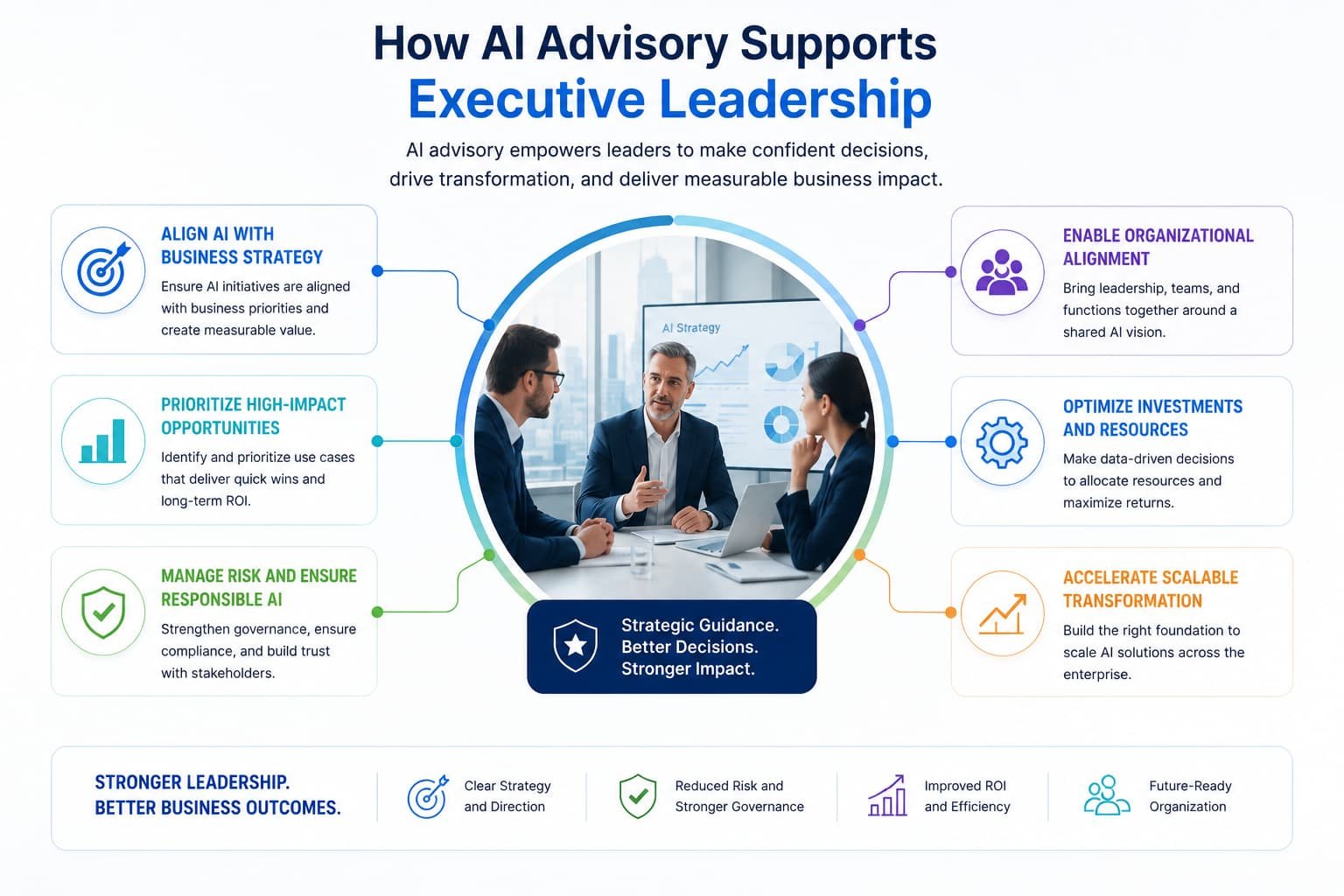
How AI advisory supports executive leadership decisions
Executive leadership plays a critical role in determining whether AI transformation succeeds or fails. While technical teams implement AI solutions, leadership teams define the vision, investment priorities, and governance strategies that shape long-term outcomes. Without clear executive alignment, AI initiatives often become fragmented and fail to generate measurable value.
AI advisory helps organizations build structured AI roadmaps that align innovation with business objectives and operational realities. Instead of launching disconnected AI projects, leadership teams can prioritize initiatives based on scalability, feasibility, and business impact. As a result, organizations can reduce implementation risks while scaling AI more effectively.
Additionally, AI advisory helps executives evaluate AI investments and develop responsible generative AI strategies. Advisors guide organizations in identifying high-value use cases while ensuring governance, data security, and compliance remain priorities. Consequently, businesses can move beyond experimentation and create scalable AI transformation strategies that support long-term growth.
Common Challenges in AI Transformation
- Lack of Strategic Alignment
Many organizations adopt AI tools without defining clear business goals. As a result, AI initiatives often become disconnected from operational priorities and fail to deliver measurable outcomes. - Poor Data Readiness
AI systems cannot produce reliable insights without strong data foundations. Fragmented systems and inconsistent governance frequently limit scalability and operational performance. - Employee Resistance to Change
Workforce concerns around automation and job disruption can slow AI adoption significantly. Therefore, organizations must prioritize communication, reskilling, and employee engagement throughout the transformation process. - Governance Gaps
Rapid AI implementation without governance frameworks increases compliance, security, and reputational risks. Businesses that establish governance early can scale AI more responsibly and sustainably.
Best Practices for Successful AI Transformation
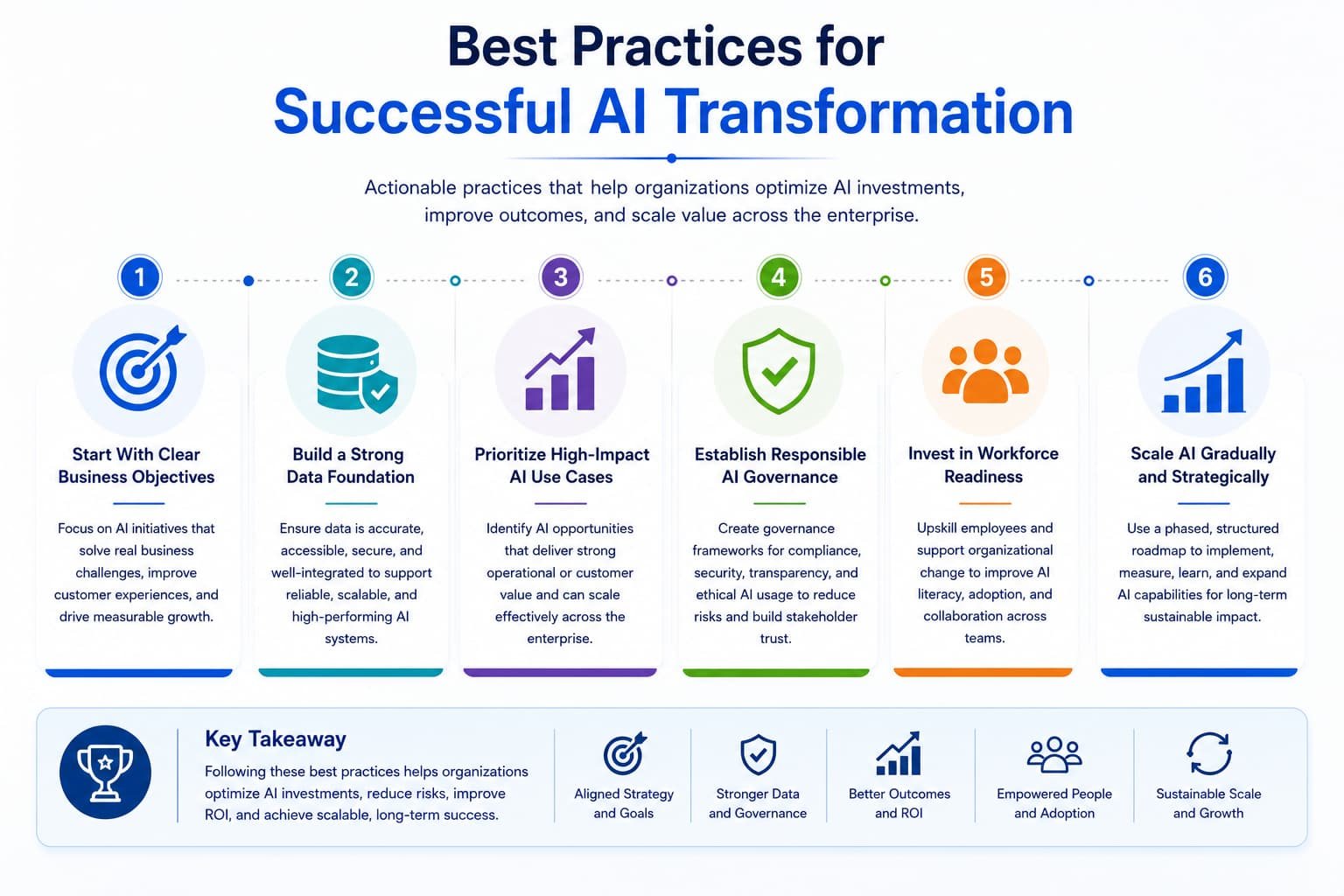
Best practices for successful enterprise AI transformation
Successful AI transformation requires a clear strategy, strong governance, and workforce readiness. Organizations that take a structured approach are more likely to scale AI effectively and achieve measurable business outcomes.
- Start With Clear Business Objectives
Organizations should focus on AI initiatives that solve operational challenges, improve customer experiences, or support measurable business growth. Aligning AI with strategic goals helps businesses improve ROI and avoid fragmented adoption. - Build a Strong Data Foundation
Successful AI systems depend on high-quality, secure, and well-integrated data. Businesses should strengthen data governance, infrastructure, and accessibility to support scalable and reliable AI transformation. - Prioritize High-Impact AI Use Cases
Companies should identify AI opportunities that deliver measurable business value and can scale effectively across the enterprise. Prioritizing practical use cases helps organizations achieve faster wins and long-term transformation success. - Establish Responsible AI Governance
Strong governance frameworks help businesses manage compliance, security, transparency, and ethical AI usage. Organizations that embed governance early can reduce operational risks and build greater stakeholder trust. - Invest in Workforce Readiness and Change Management
AI transformation succeeds faster when employees understand how AI supports productivity and innovation. Businesses should invest in AI literacy, reskilling, and change management to improve adoption across teams. - Scale AI Through Structured Implementation
Organizations should avoid launching disconnected AI projects without a long-term roadmap. A phased and structured implementation strategy helps businesses scale AI more efficiently while improving operational outcomes and sustainability.
Businesses that follow these practices can scale AI more efficiently while reducing operational risks and improving long-term value.
The Future of AI Advisory
AI advisory will continue evolving as organizations shift from basic generative AI to more advanced technologies like agentic AI systems, autonomous agents, predictive intelligence, and enterprise automation platforms. Advisors will focus on helping companies build AI-native business models, orchestrate complex AI ecosystems, and redesign workflows for maximum efficiency.
According to Stanford’s AI Index 2026, agentic and multi-agent AI systems are among the fastest-growing areas, with enterprise experimentation expected to surge significantly in 2027. In the coming years, the focus will shift toward responsible AI at scale, workforce redesign for human-AI collaboration, and sustainable strategies that balance innovation with strong governance and security.
Companies partnering with experienced AI advisors today will be far better positioned to adapt, compete, and succeed in an AI-driven future.
Final Thoughts
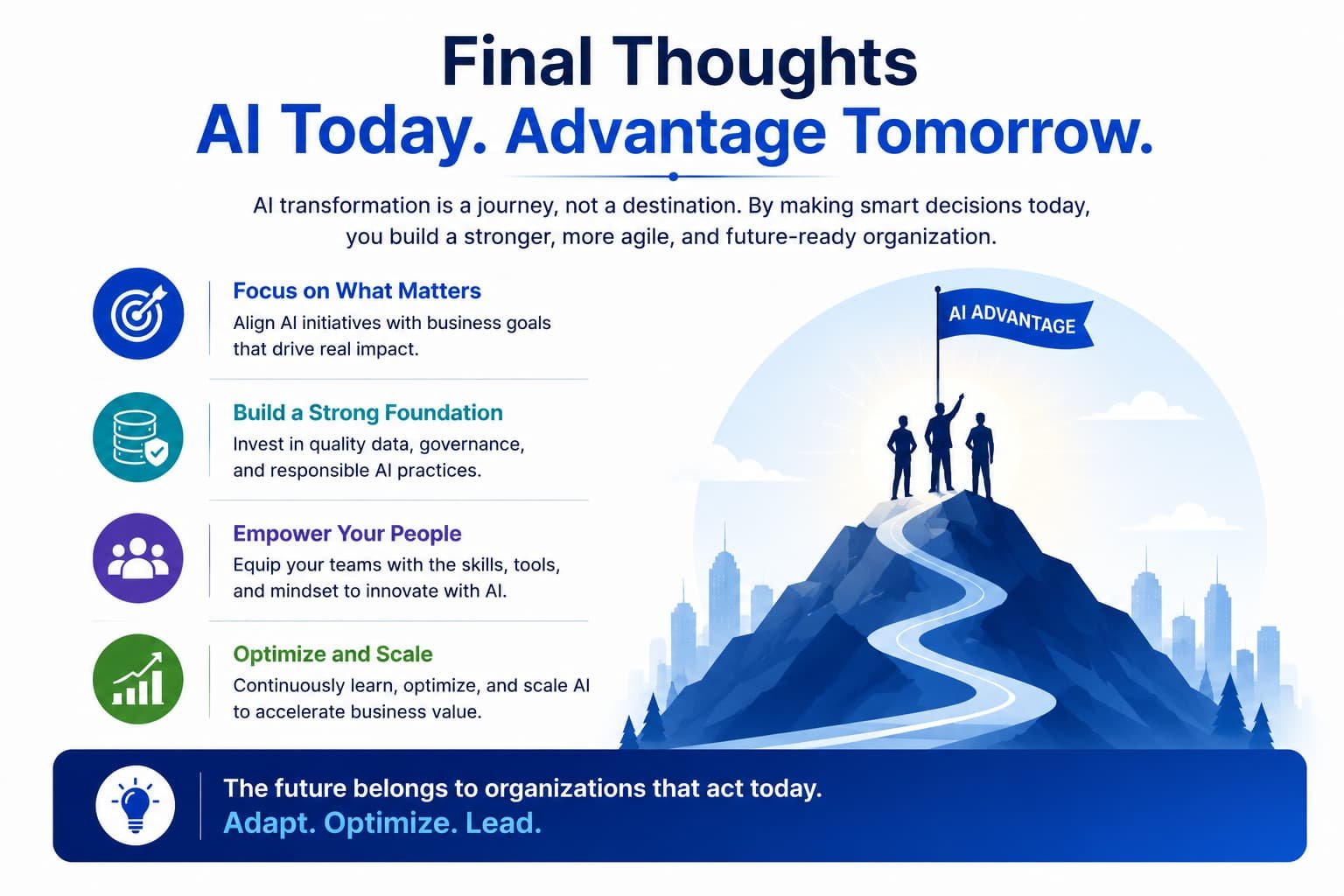
Key takeaways for successful enterprise AI transformation
AI transformation is no longer just a technology initiative. It is a business strategy that influences operations, workforce productivity, customer experience, and long-term competitive advantage.
However, successful AI adoption requires more than implementing advanced tools. Organizations need leadership alignment, governance frameworks, workforce readiness, and a clear transformation roadmap to scale AI effectively.
AI advisory provides the strategic guidance businesses need to navigate this complexity with confidence. As AI continues to reshape industries, organizations that invest in structured and responsible AI transformation strategies will be better positioned for sustainable growth, innovation, and long-term success.