

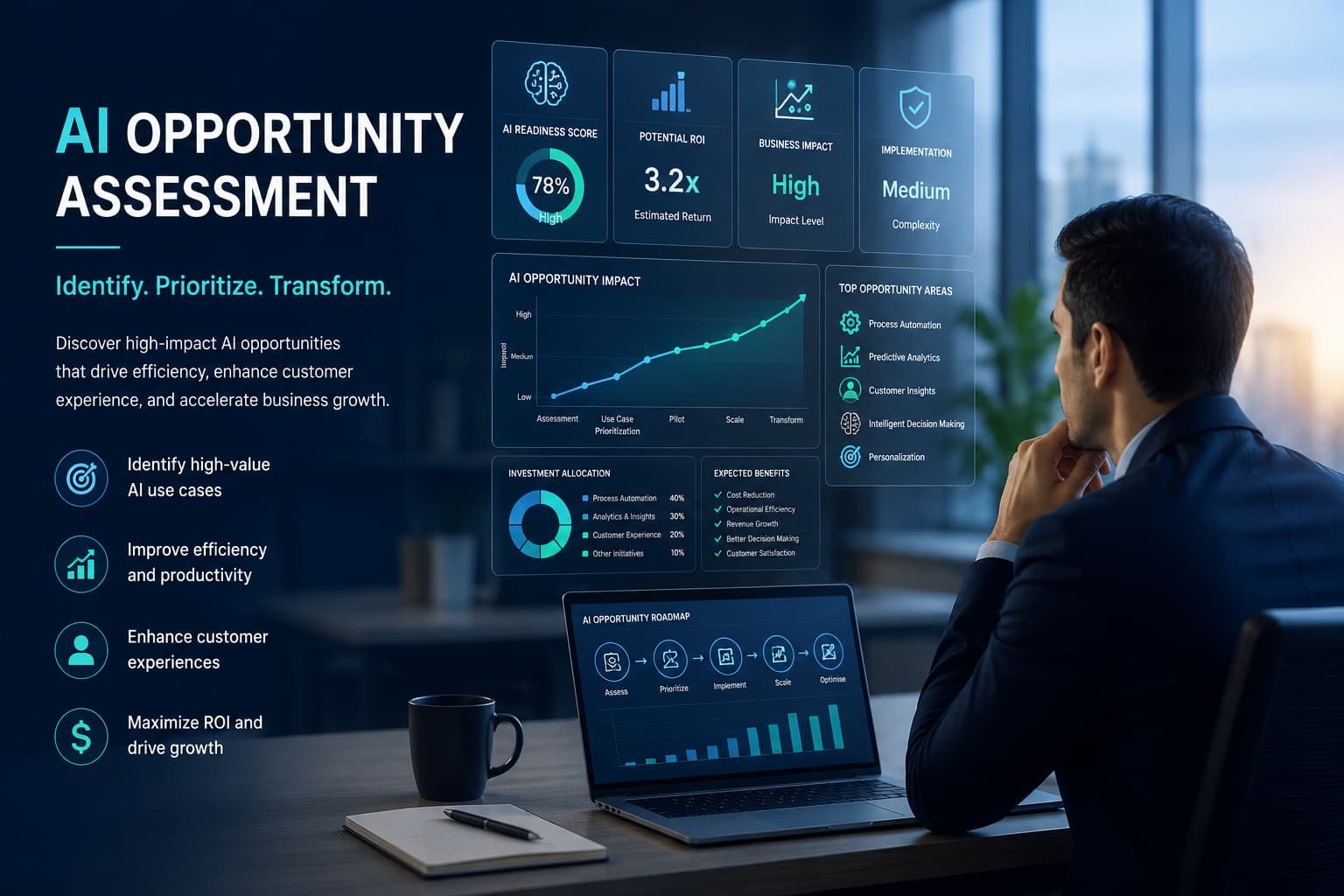
Artificial intelligence is becoming a fundamental part of modern business strategy as organizations look for smarter ways to improve efficiency, automate operations, and enhance customer experiences. Companies across industries are increasingly integrating AI into everyday workflows to strengthen decision-making and unlock new growth opportunities.
According to McKinsey & Company, nearly 65% of organizations now use generative AI in at least one business function, highlighting how quickly enterprise adoption is accelerating.
Despite growing investment, many businesses still struggle to translate AI adoption into measurable outcomes. Organizations often implement AI tools without fully understanding where the technology can deliver the strongest operational or financial impact. An AI opportunity assessment helps businesses evaluate data readiness, workflow challenges, and high-value use cases so AI initiatives are aligned with broader organizational priorities rather than short-term experimentation.
Competitive pressure and rising customer expectations are also pushing businesses to approach AI more strategically. Research from PwC estimates that AI could contribute up to $15.7 trillion to the global economy by 2030. Companies that begin with a structured assessment process are often better positioned to reduce implementation risks, scale AI initiatives effectively, and create long-term business value from their technology investments.
Why AI Opportunity Assessment Matters
AI adoption is expanding rapidly as businesses move beyond experimentation and integrate intelligent technologies into everyday operations. However, successful implementation depends on understanding where AI can create measurable value instead of applying it across every process.
An AI opportunity assessment helps organizations identify the most impactful use cases while ensuring investments align with operational priorities and long-term growth plans. According to IBM, 42% of enterprises have already actively deployed AI, making strategic evaluation more important than ever.
- Identifies High-Impact Use Cases
An assessment helps businesses pinpoint areas where AI can improve workflow efficiency, automate repetitive tasks, and enhance customer experiences. This allows organizations to focus on initiatives with stronger business outcomes and ROI potential. - Evaluates Data and Infrastructure Readiness
AI systems perform best when supported by reliable data and scalable infrastructure. Assessments help companies identify gaps in data quality, accessibility, integration, and technology readiness before implementation begins. - Reduces Operational and Implementation Risks
Many AI projects struggle because of unclear goals, unrealistic expectations, or fragmented deployment strategies. A structured assessment highlights technical limitations, compliance concerns, and operational risks early in the process. - Strengthens Strategic Decision-Making
AI opportunity assessments help leadership teams align technology investments with broader organizational priorities. This creates a more focused approach to AI adoption instead of reacting to industry trends or competitive pressure. - Accelerates Digital Transformation Efforts
Organizations with a clear understanding of AI opportunities can deploy solutions faster and scale them more effectively across departments, workflows, and customer operations.
Key Areas Evaluated During an AI Opportunity Assessment
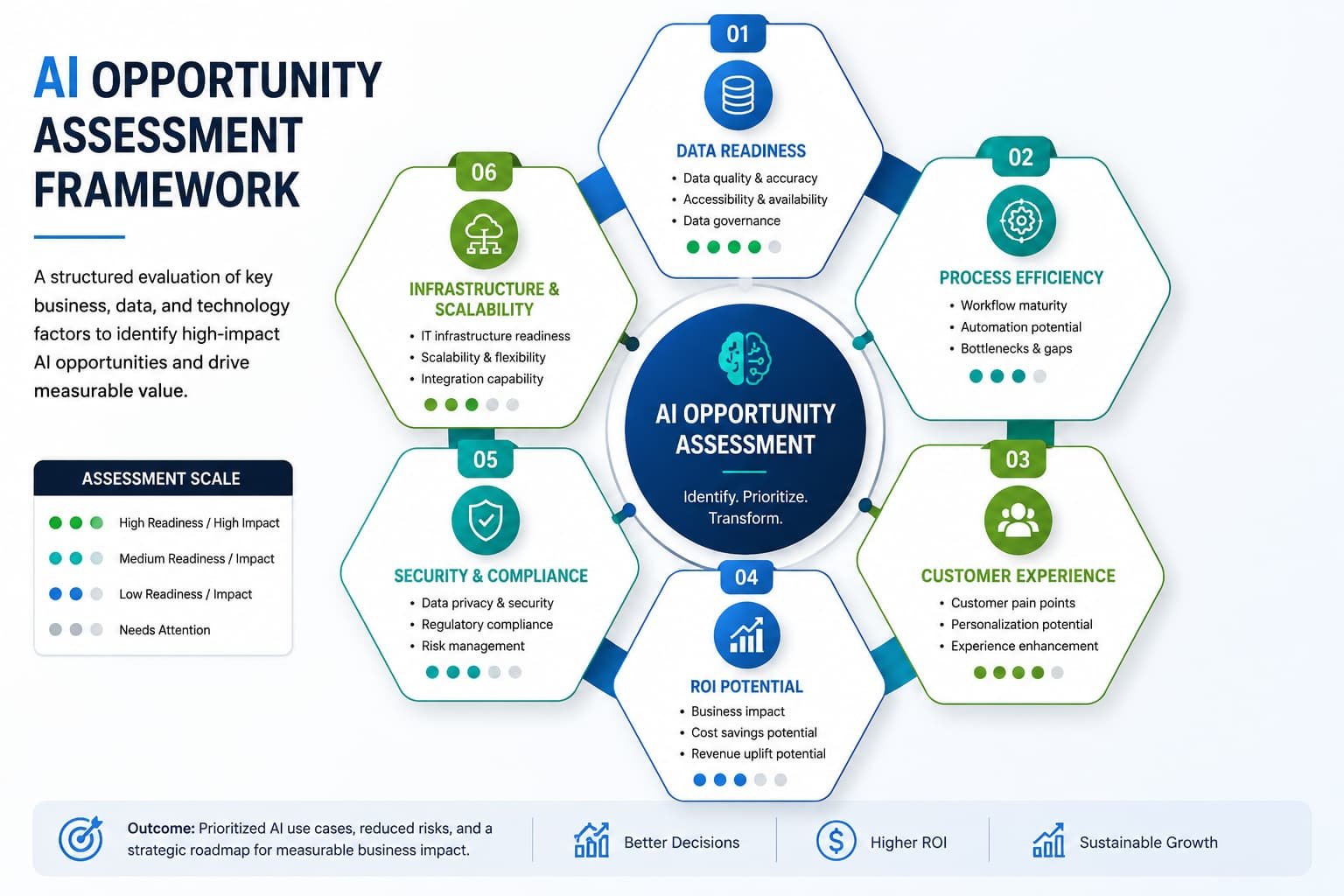
AI Opportunity Assessment Framework Overview
An AI opportunity assessment examines far more than automation potential. It helps organizations understand where AI can realistically improve operations, support decision-making, and deliver measurable business value. The process evaluates existing workflows, technology readiness, and organizational challenges to identify opportunities that align with long-term business priorities instead of isolated experimentation.
The assessment also provides leadership teams with greater clarity around scalability, implementation complexity, and operational risks. According to Deloitte, organizations with clearly defined AI strategies are significantly more likely to achieve measurable business improvements and sustained adoption success.
- Business process inefficiencies and workflow bottlenecks
- Data quality, accessibility, and governance readiness
- Customer experience and personalization opportunities
- Repetitive operational tasks suitable for automation
- Compliance, cybersecurity, and ethical AI considerations
- Existing infrastructure and long-term scalability potential
Organizations that evaluate these areas early are often better prepared to implement AI efficiently and avoid fragmented adoption strategies. A structured assessment also encourages stronger collaboration between leadership, operational teams, and technical departments, helping businesses create a more practical and scalable AI roadmap.
Common Challenges Businesses Face Without AI Assessment
Many organizations adopt AI quickly without fully understanding where it can create meaningful business value. This often leads to disconnected systems, unclear priorities, and projects that fail to deliver measurable results. Without a structured assessment process, businesses may invest in AI tools that do not align with operational needs or long-term goals, increasing costs and slowing adoption.
Data readiness is another major challenge businesses frequently overlook. AI systems depend on accurate, accessible, and well-managed data, yet many organizations still operate with fragmented databases and outdated infrastructure. According to Gartner, poor data quality remains one of the leading reasons AI initiatives fail to meet expectations. Weak data foundations can limit AI performance and scalability.
Organizations also struggle with workforce alignment and implementation planning when AI strategies are unclear. Teams may resist adoption due to uncertainty around workflows, responsibilities, and business objectives. A lack of assessment can further create compliance risks, operational inefficiencies, and unrealistic expectations. Businesses that evaluate AI opportunities early are often better prepared to scale initiatives effectively and achieve long-term results.
Best Practices for Conducting an AI Opportunity Assessment
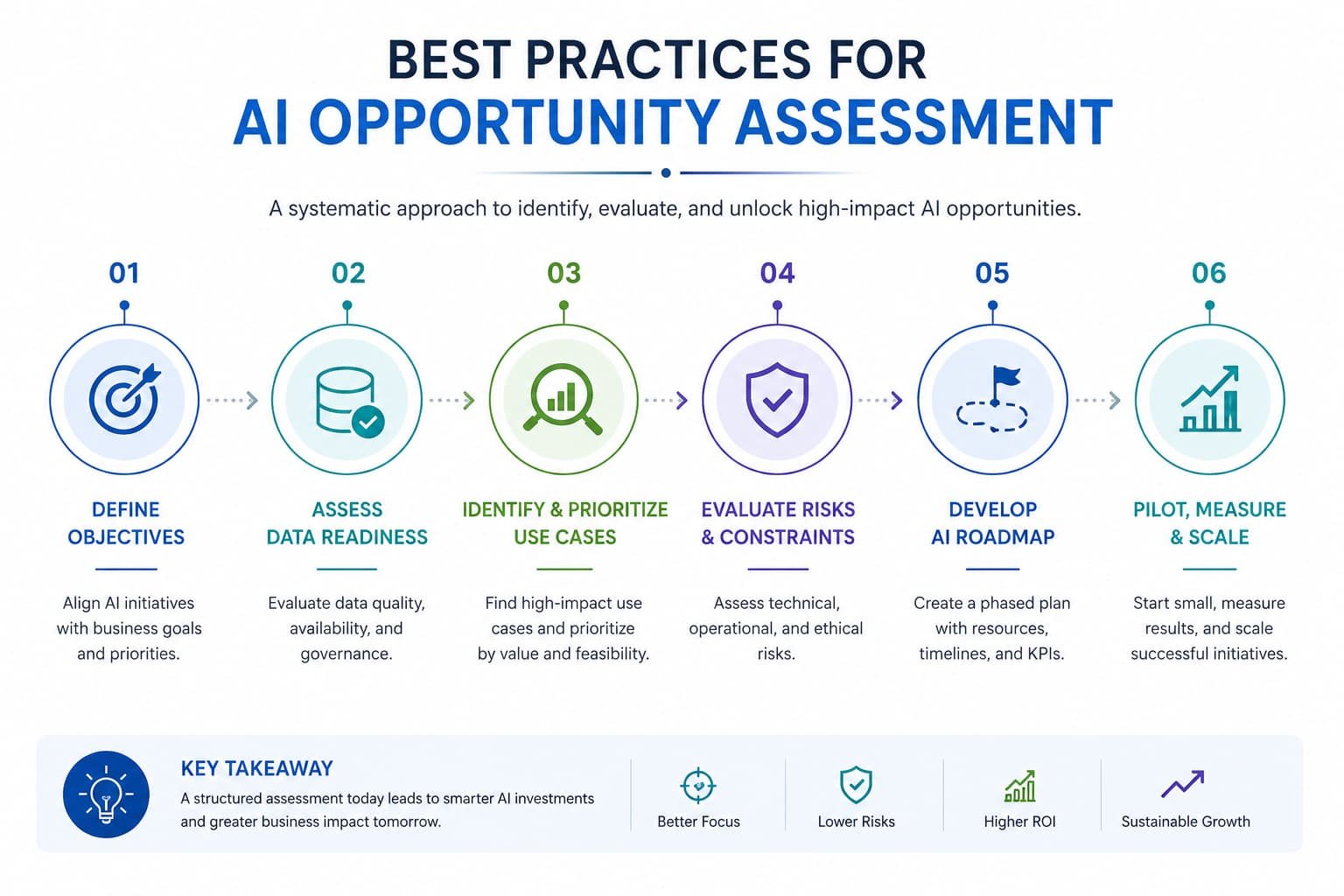
AI Opportunity Assessment Best Practices Roadmap
- Define Clear Business Objectives
Successful AI initiatives start with a strong understanding of organizational priorities. Businesses should focus on solving operational challenges and improving measurable outcomes instead of adopting AI purely to follow market trends. - Prioritize High-Value Use Cases
Organizations often achieve better results when they begin with use cases that can improve productivity, reduce costs, or strengthen customer experience. Focusing on practical applications helps generate faster ROI and smoother adoption. - Assess Data Readiness Early
AI systems rely heavily on reliable and accessible data. Companies should evaluate data quality, security, governance, and accessibility before implementing AI-driven solutions. - Encourage Cross-Functional Collaboration
AI opportunity assessments become more effective when leadership teams, IT departments, operations, and customer-facing teams work together. Collaboration helps identify realistic opportunities and operational challenges early in the process. - Evaluate Scalability and System Integration
AI solutions should integrate smoothly with existing workflows and technology infrastructure. Businesses also need to ensure their systems can support future growth without creating unnecessary complexity. - Monitor Governance and Compliance Risks
Responsible AI adoption requires careful attention to cybersecurity, regulatory compliance, and data privacy. Early risk assessment helps organizations reduce disruptions and maintain customer trust. - Build a Phased Implementation Strategy
Companies often see stronger results when AI adoption happens gradually rather than through large-scale deployment at once. A phased strategy allows teams to test performance, optimize processes, and scale more efficiently.
The Future of AI Opportunity Assessment in Business Strategy
AI adoption is evolving from experimental projects into a core part of long-term business strategy. Organizations are increasingly using AI for predictive analytics, intelligent decision-making, workflow optimization, and personalized customer experiences. As industries become more competitive, AI opportunity assessments are becoming an important part of strategic planning rather than a one-time technology evaluation.
The rise of generative AI is also reshaping how businesses identify growth and innovation opportunities. According to McKinsey & Company, generative AI could contribute trillions of dollars in economic value through productivity improvements and operational efficiency. This shift is encouraging companies to evaluate AI not only for cost reduction, but also for scalability, innovation, and long-term competitive advantage.
Organizations that regularly assess AI opportunities are often better prepared for changing market demands and customer expectations. Continuous evaluation helps businesses refine implementation strategies, identify new use cases, and align AI investments with evolving business priorities. Companies that combine structured planning with responsible AI adoption are likely to build stronger digital capabilities and maintain a competitive advantage in the years ahead.
How AI Opportunity Assessment Improves ROI
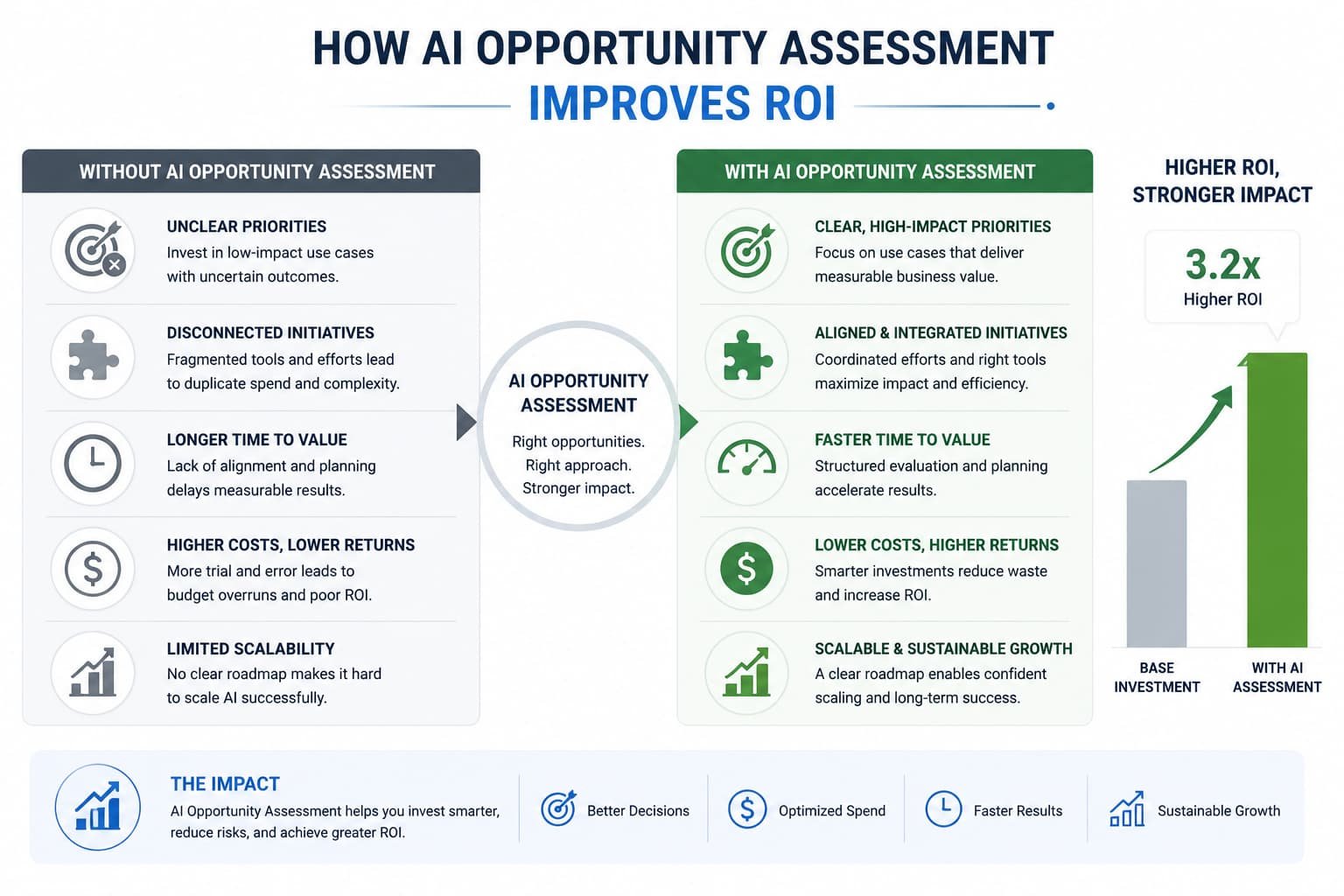
How AI Opportunity Assessment Improves ROI
Many businesses struggle to achieve measurable returns from AI because projects are implemented without a clear strategy. An AI opportunity assessment helps organizations identify where AI investments can create the highest operational and financial impact. Instead of applying AI across every department, businesses can focus on high-value areas that improve efficiency, reduce manual work, and strengthen performance.
A structured assessment also helps reduce unnecessary spending on tools, infrastructure, and implementation mistakes. According to Accenture, organizations that scale AI strategically are more likely to achieve stronger revenue growth and operational efficiency. Clear prioritization allows businesses to allocate resources more effectively while improving time-to-value.
- Improves operational efficiency through targeted automation
- Reduces implementation costs and project failures
- Helps prioritize AI investments with stronger ROI potential
- Supports faster decision-making with data-driven insights
- Enhances customer experience through intelligent personalization
- Builds scalability for long-term AI adoption
Organizations that align AI investments with broader business priorities are often better positioned to achieve sustainable growth and long-term digital transformation success.
Industries Where AI Opportunity Assessment Creates the Biggest Impact
Industries are adopting AI at different speeds, but strategic assessment remains essential across sectors. Businesses are using AI opportunity assessments to identify where automation, predictive analytics, and intelligent decision-making can improve efficiency and customer experience. According to PwC, AI-driven transformation is expected to contribute significantly to global productivity growth in the coming years.
- Healthcare
Healthcare organizations are using AI assessments to identify opportunities in diagnostics, patient engagement, administrative automation, and treatment planning. These evaluations help providers improve efficiency while supporting better patient outcomes. - Retail and E-commerce
Retail businesses are focusing on AI-powered personalization, demand forecasting, customer analytics, and inventory optimization. Opportunity assessments help brands improve customer experience and increase sales performance. - Banking and Financial Services
Financial institutions are adopting AI for fraud detection, risk analysis, automated customer support, and data processing. Structured assessments help organizations prioritize secure and compliant AI implementation. - Manufacturing and Supply Chain
Manufacturers are using AI to improve predictive maintenance, production efficiency, and supply chain visibility. Assessments help businesses identify bottlenecks and opportunities for intelligent automation. - Logistics and Transportation
AI opportunity assessments support route optimization, fleet management, and demand forecasting in logistics operations. Businesses can improve delivery efficiency while reducing operational delays and costs.
Moving Forward With a Smarter AI Strategy
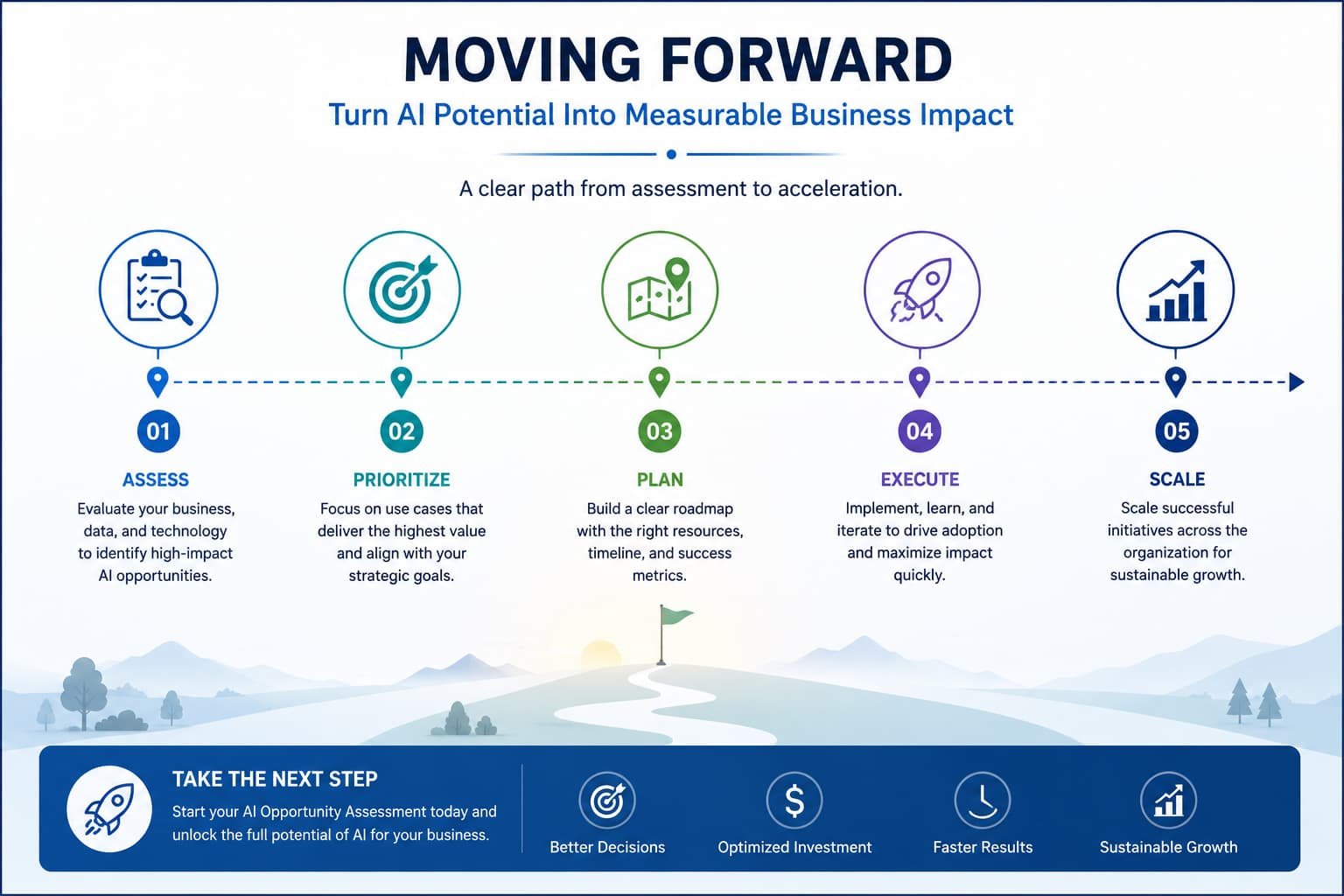
AI Opportunity Assessment Growth Roadmap
AI adoption is accelerating across industries, but successful implementation requires more than simply adopting new technology. Businesses need a clear understanding of where AI can create value, support organizational goals, and integrate effectively with existing systems. An AI opportunity assessment helps organizations identify the right use cases, reduce implementation risks, and build a scalable path for growth.
Companies that approach AI strategically are often better positioned to improve efficiency, strengthen customer experiences, and stay competitive in a rapidly evolving market. As AI capabilities continue to advance, businesses that regularly assess opportunities and refine their strategies are more likely to achieve sustainable long-term growth and stronger digital transformation outcomes.