

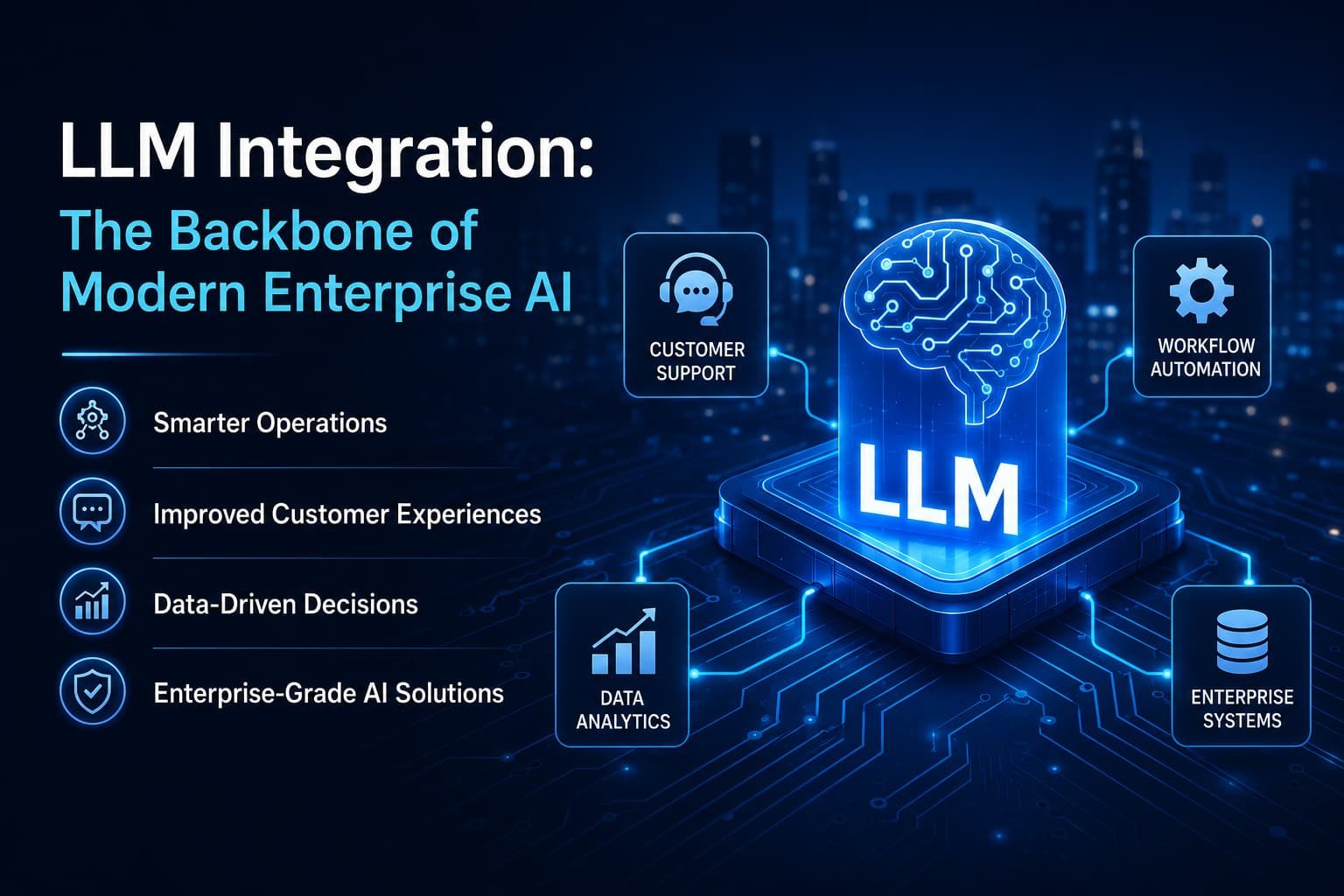
Large Language Model (LLM) integration has become a core part of modern business strategy. Companies in healthcare, finance, retail, and SaaS now use AI to deliver superior customer support, automate workflows, and boost productivity. Instead of treating LLMs as basic chatbots, tech-driven businesses embed them deeply into daily operations to create faster, smarter experiences.
This rapid adoption of enterprise AI is clearly visible in spending trends. In 2025, global investment in LLM technologies surpassed $8 billion. Organizations use LLM integration to reduce manual work, improve decision-making, and deliver personalized customer interactions. As a result, AI integration has quickly turned into a competitive necessity.
Modern LLM integration goes far beyond simple API calls. Companies now combine LLMs with RAG pipelines, vector databases, and automation tools to build powerful, scalable AI ecosystems. Therefore, businesses must focus on security, performance, and compliance from the start.
Why Businesses Are Prioritizing LLM Integration
Businesses adopt LLMs rapidly because these models boost efficiency, slash operational costs, and enhance customer experiences. They power intelligent virtual assistants, perform advanced data analysis, and automate repetitive tasks while delivering faster, more accurate results. As a result, companies that implement AI-driven workflows see major gains in productivity and customer engagement.
- Improved Automation: LLMs handle content creation, customer queries, documentation, and workflow management. This shift allows teams to spend less time on repetitive work and focus on strategic initiatives.
- Better Customer Experience: AI chatbots and virtual assistants provide instant, personalized support. Consequently, customer satisfaction and response times improve significantly.
- Data-Driven Insights: LLM-powered systems analyze massive datasets in seconds and generate actionable insights. Therefore, leaders can make faster and smarter business decisions.
- Higher Operational Efficiency: AI integration reduces manual errors and speeds up processes. Companies can also scale operations without proportionally increasing headcount
- Competitive Advantage: Early adopters of enterprise AI strengthen their market position. Furthermore, advanced AI capabilities help brands innovate faster and adapt to evolving customer needs.
Key Technologies Powering Modern LLM Integration
Key Technologies Behind Modern LLM Integration
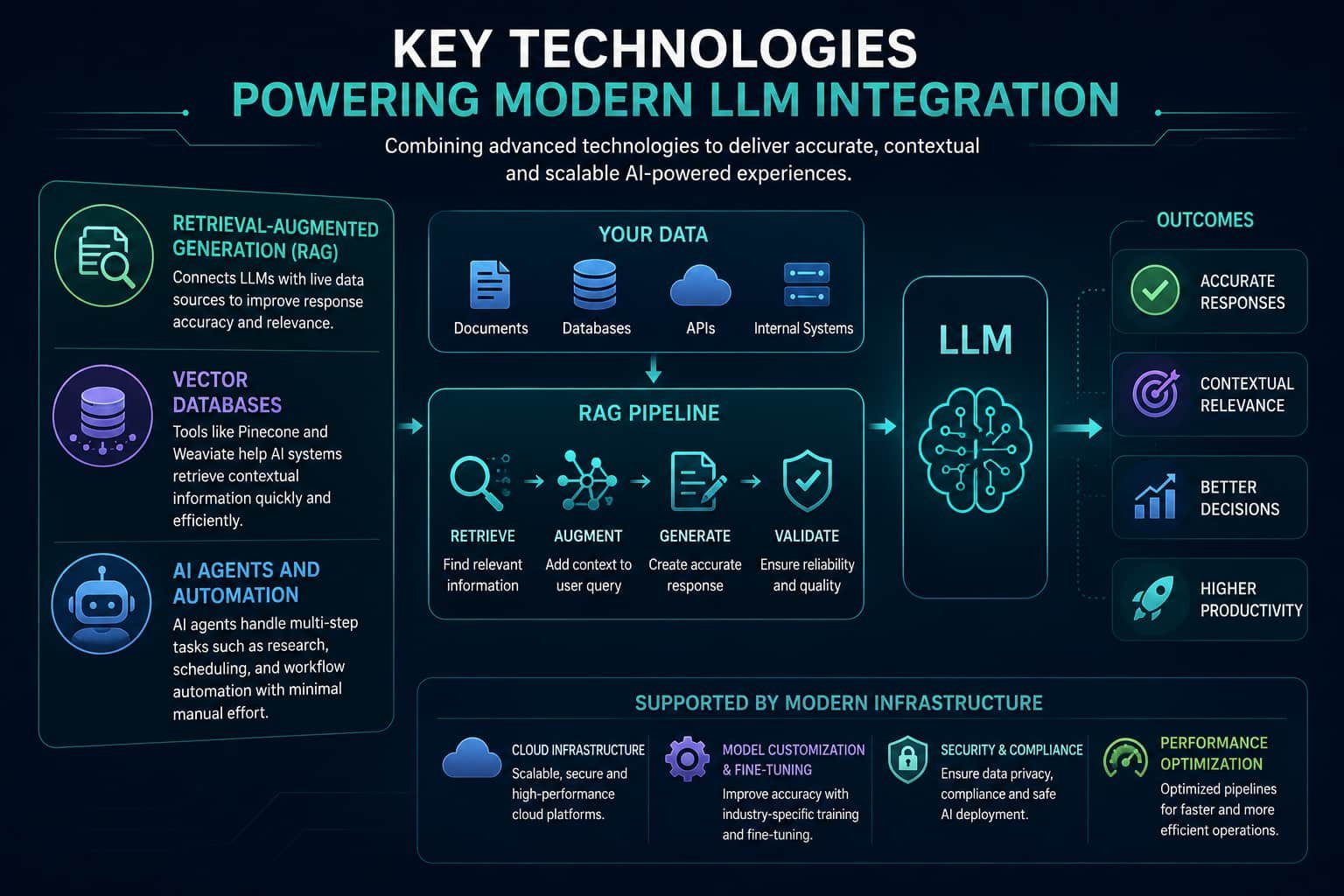
Modern LLM integration relies on AI infrastructure, retrieval systems, and automation frameworks to improve accuracy and scalability. Instead of using standalone language models, businesses combine multiple technologies to create faster, more context-aware AI systems. This approach helps organizations deliver reliable and efficient AI-powered experiences.
Retrieval-Augmented Generation (RAG) is one of the most important technologies in enterprise AI. It connects LLMs with external data sources like documents, databases, and internal systems. As a result, AI models provide more accurate and updated responses instead of relying only on pre-trained information.
- Retrieval-Augmented Generation (RAG): Connects LLMs with live data sources to improve response accuracy and relevance.
- Vector Databases: Tools like Pinecone and Weaviate help AI systems retrieve contextual information quickly and efficiently.
- AI Agents and Automation: AI agents handle multi-step tasks such as research, scheduling, and workflow automation with minimal manual effort.
Benefits of LLM Integration for Businesses
LLMs help businesses boost efficiency, cut operational costs, and enhance customer experiences. These models automate repetitive tasks and streamline workflows, which frees teams to focus on higher-value work and drives higher productivity. As a result, organizations that adopt AI gain a strong competitive edge as adoption accelerates across industries.
- Higher productivity through workflow automation.
- Faster customer support with AI chatbots.
- Better personalization using user data insights.
- Smarter decisions with real-time analytics.
- Reduced operational costs through automation.
- Easier scalability with cloud-based AI systems.
LLM Integration Use Cases Across Industries
LLM integration is transforming industries through better automation, customer engagement, and decision-making. Specifically, AI-powered systems now help companies across sectors streamline workflows, analyze data, and deliver personalized experiences. As enterprise AI adoption grows, industry-specific LLM applications are becoming a key driver of efficiency and innovation.
| Industry | LLM Integration Use Case | Business Impact |
|---|---|---|
| Healthcare | AI-powered patient support and documentation | Faster service and improved efficiency |
| Finance | Fraud detection and automated reporting | Better risk management and compliance |
| Retail | Personalized product recommendations | Higher customer engagement and sales |
| SaaS | AI copilots and workflow automation | Increased productivity and faster operations |
| Education | Intelligent tutoring and content generation | Improved learning experiences |
| Customer Service | AI chatbots and virtual assistants | Reduced response times and support costs |
The adoption of LLM integration across industries is growing rapidly. Organizations continue investing in AI-driven solutions to improve scalability, reduce costs, and enhance user experiences. Consequently, businesses using industry-specific AI strategies will gain a stronger competitive advantage.
Challenges in LLM Integration
Key Challenges in Enterprise LLM Integration
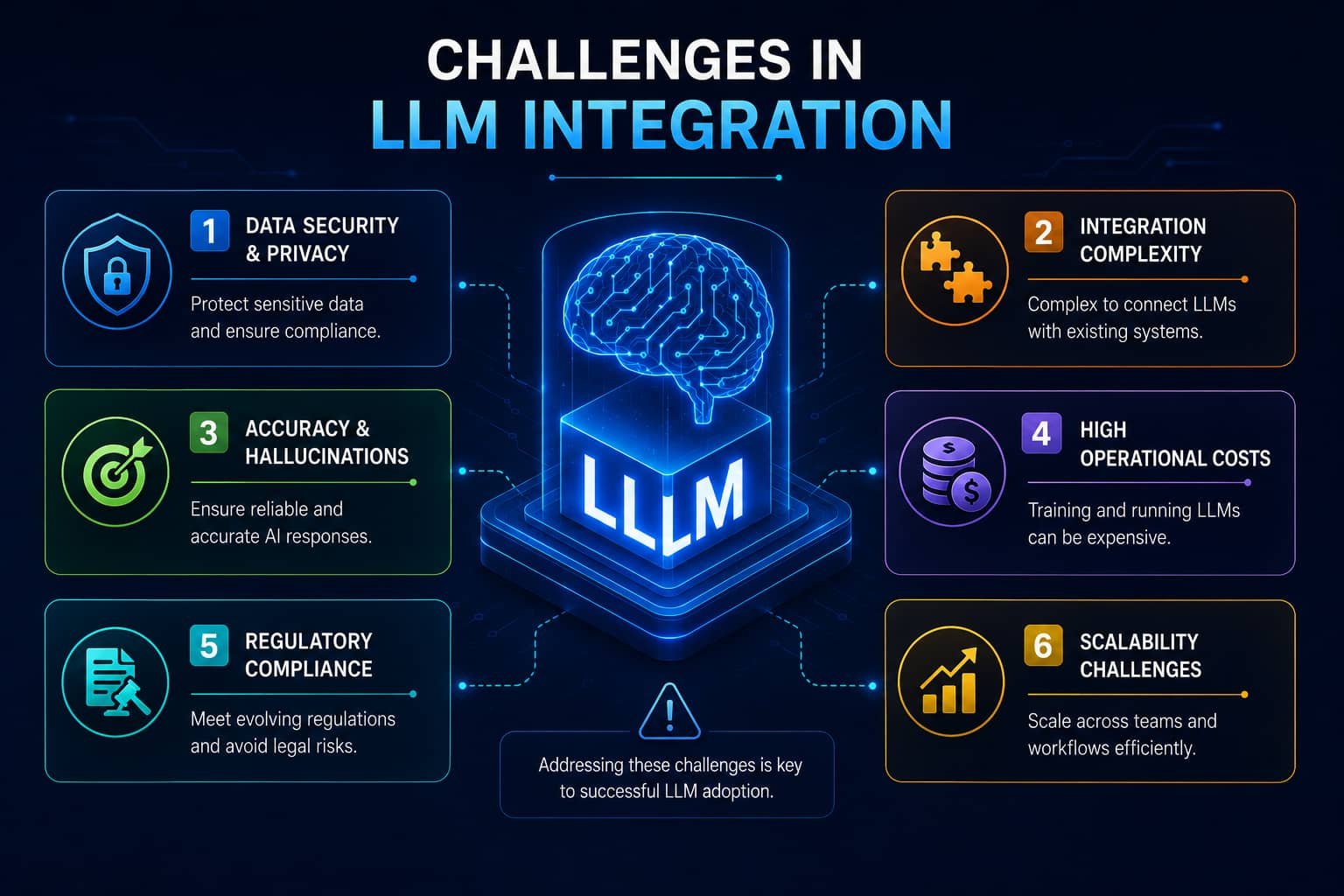
- Data Security and Privacy: Businesses handling sensitive customer or enterprise data must ensure secure AI deployment. Strong encryption, access controls, and compliance frameworks are essential to reduce security risks.
- Integration Complexity: Connecting LLMs with existing enterprise systems often requires advanced infrastructure and technical expertise. This frequently leads to deployment delays and higher implementation costs.
- Accuracy and Hallucinations: LLMs can sometimes generate incorrect or misleading responses. That’s why, businesses must use validation systems and human oversight to maintain reliability.
- High Operational Costs: Training, fine-tuning, and running large AI models require significant computing resources. To manage this, companies need cost-efficient AI strategies to manage long-term scalability.
- Regulatory Compliance: Growing AI regulations require businesses to maintain transparency, data protection, and ethical AI practices. Organizations must continuously adapt to evolving compliance standards.
- Scalability Challenges: Expanding LLM integration across multiple departments and workflows can increase infrastructure demands. Businesses must optimize performance and system reliability to support long-term AI growth.
Future Trends in LLM Integration
Future Trends Shaping LLM Integration
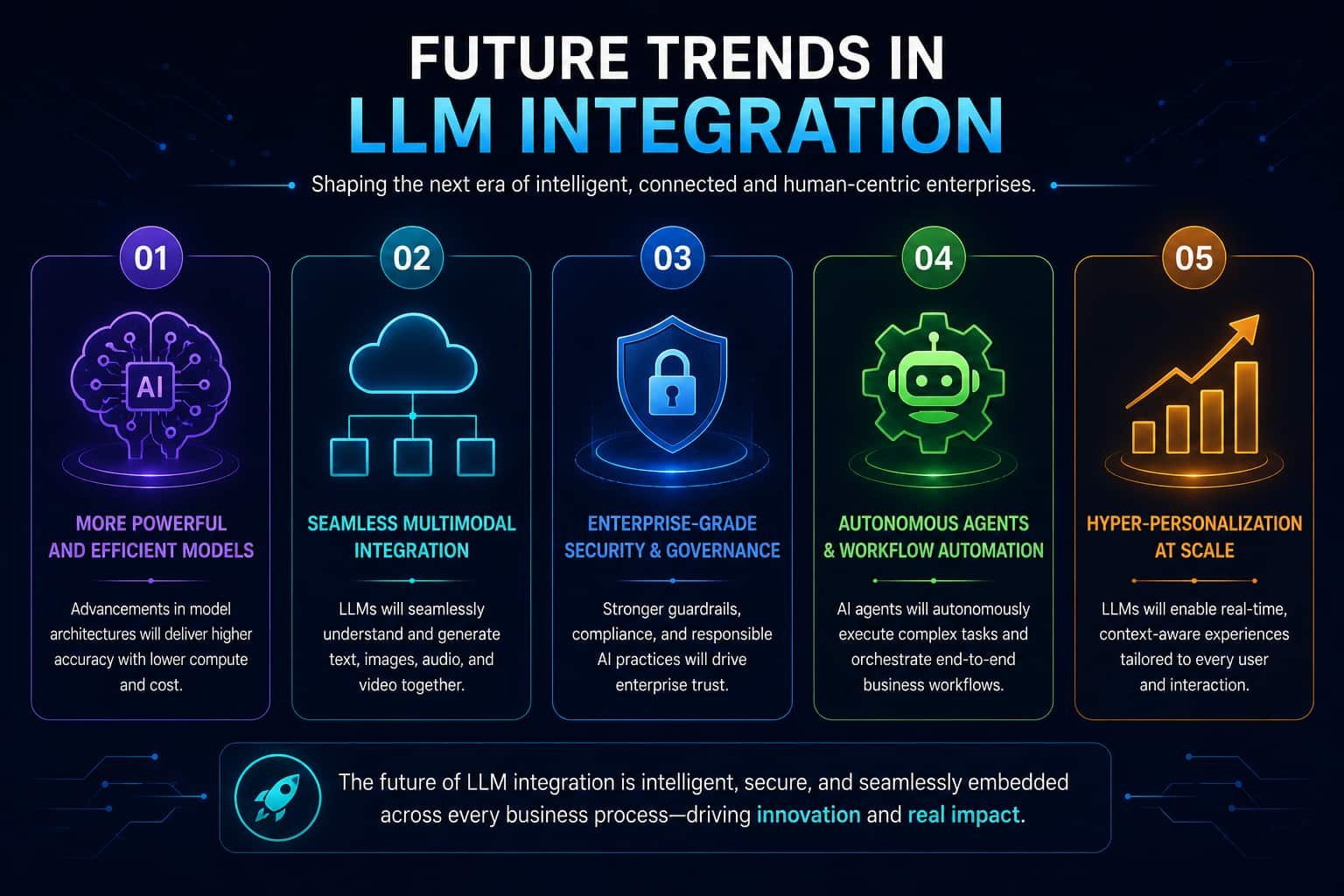
LLMs are evolving rapidly as businesses adopt AI agents, multimodal models, and real-time automation. Companies are investing in solutions that process text, images, audio, and video for smarter interactions. Meanwhile, smaller efficient models are gaining popularity because they cut costs while maintaining strong performance. As a result, businesses can deploy AI faster and at scale.
Enterprise strategies are also shifting toward personalized and industry-specific LLMs. Fine-tuned models trained on company data improve both accuracy and security. Advancements in edge AI and cloud infrastructure further enhance flexibility. Consequently, adaptable AI ecosystems will deliver stronger competitive advantages.
The Road Ahead for LLM Integration
LLM integration has moved beyond experimental projects into core business operations. Organizations now use AI-powered systems to drive automation, customer engagement, and operational efficiency. Companies that adopt scalable and secure AI strategies will accelerate digital transformation and achieve sustainable growth.
Success will depend on how effectively businesses embed LLMs into daily workflows while upholding security, compliance, and performance standards. Those investing in intelligent automation, real-time analytics, and customized models will strengthen their competitive position for years to come.