

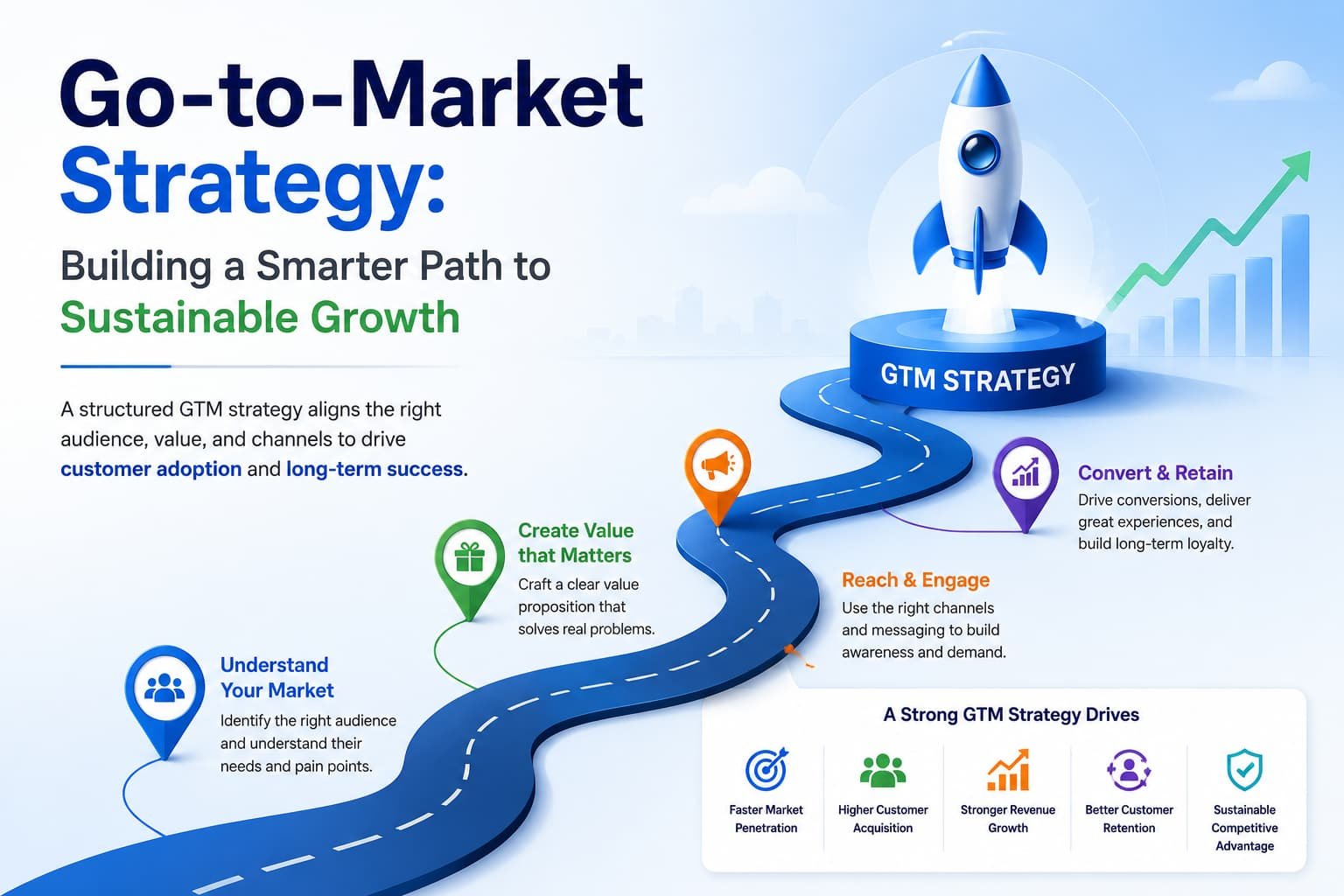
A successful product launch rarely depends on the product itself. Companies that consistently win market attention rely on a well-defined go-to-market (GTM) strategy. This approach clarifies positioning, identifies the right audience, and generates demand effectively.
Even groundbreaking products can fail to gain visibility without a structured GTM plan. For example, industry data shows that nearly 35% of startups collapse due to misreading market demand. Many others struggle because of vague messaging and imprecise targeting.
As a result, organizations with a clear GTM framework typically enjoy stronger customer acquisition, faster revenue growth, and higher retention rates. The rise of customer data and AI-powered insights has also made GTM planning far more precise and results-oriented.
Whether launching a SaaS platform, D2C product, or enterprise solution, an effective go-to-market strategy aligns marketing, sales, and customer success teams. Such alignment creates a clear pathway for market entry, deeper customer engagement, and lasting competitive advantage.
What Is a Go-to-Market Strategy?
Essentially, a go-to-market strategy acts as a comprehensive blueprint. It outlines how a business introduces a product or service to its target audience and drives adoption. The plan defines ideal customer profiles, positioning, pricing, distribution channels, sales processes, and marketing tactics required for sustainable growth.
More importantly, this strategy synchronizes every business function toward shared objectives. At the same time, it minimizes launch risks and boosts operational efficiency.
- Target Audience Identification
A successful GTM strategy begins with understanding who the product is built for. To achieve this, businesses analyze customer pain points, buying behavior, demographics, and market demand to create accurate audience segments. - Clear Value Proposition
The value proposition explains why customers should choose the product over competitors. Strong messaging highlights specific benefits, solves real problems, and communicates business value in a simple and compelling way. - Channel Selection
Choosing the right distribution and marketing channels plays a major role in product visibility. In most cases, businesses often use a mix of organic search, paid advertising, email marketing, partnerships, and sales outreach to maximize reach. - Pricing and Positioning
Pricing directly impacts customer perception and market competitiveness. Effective positioning helps brands differentiate themselves while aligning pricing with customer expectations and product value. - Sales and Customer Acquisition Strategy
A GTM framework also defines how leads will be generated, nurtured, and converted into customers. This includes sales processes, onboarding workflows, retention strategies, and customer success planning.
Why a Go-to-Market Strategy Matters
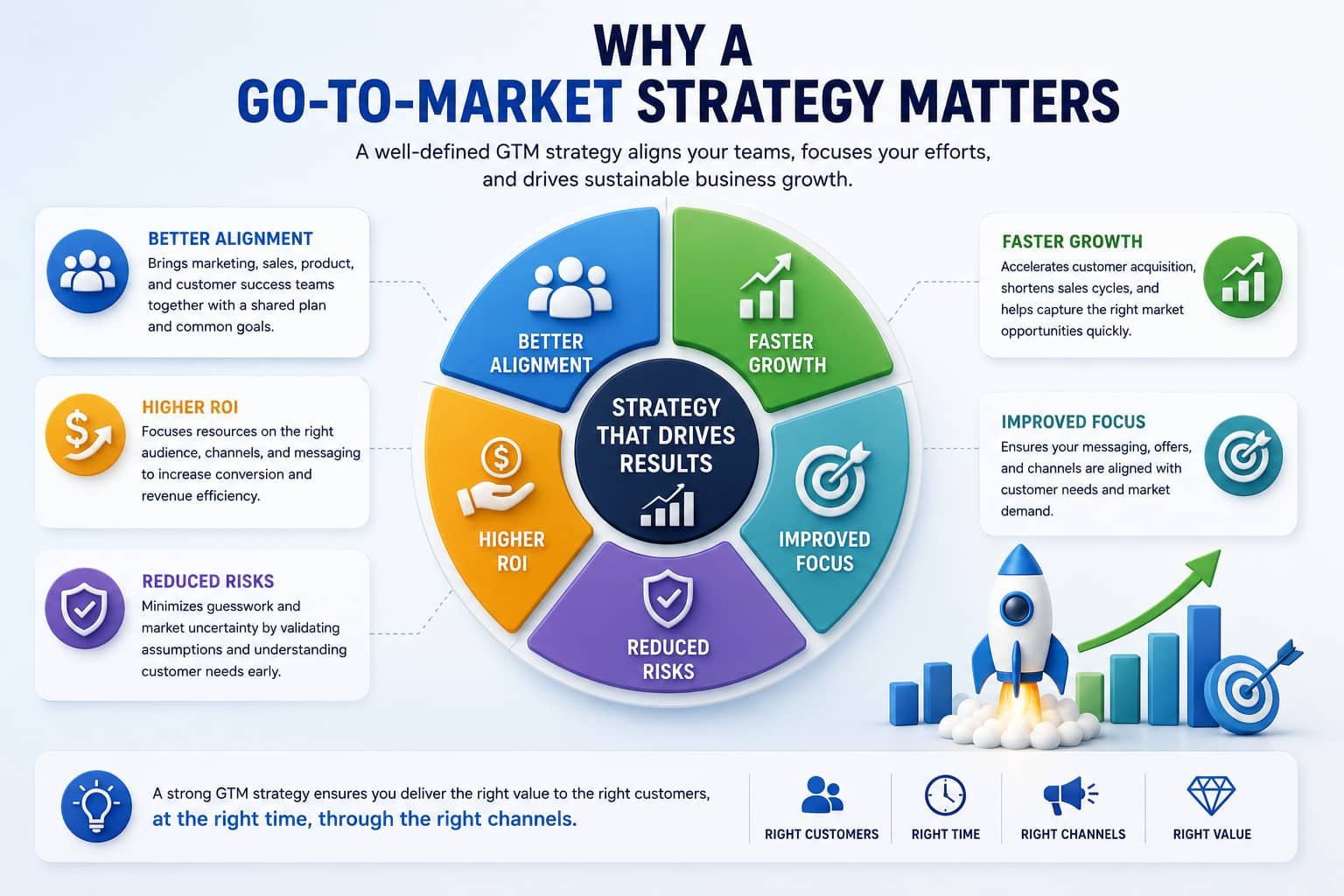
Why a Strong Go-to-Market Strategy Drives Sustainable Business Growth
Beyond supporting a product launch, a solid GTM approach reduces uncertainty and sharpens decision-making. Without it, companies frequently encounter difficulties with customer acquisition, internal alignment, and market positioning that hinder scalability.
- Companies with a defined GTM strategy are more likely to achieve faster market penetration and stronger brand visibility. Strong positioning helps customers understand the product value quickly, improving conversion rates and engagement.
- Team alignment between marketing, sales, and customer success improves coordination and creates a more consistent customer journey while reducing operational inefficiencies.
- Targeted market research and audience segmentation help companies lower customer acquisition costs. By focusing on the right segments, businesses can allocate resources more efficiently and improve ROI.
- Early go-to-market planning also supports better product-market fit by identifying customer pain points ahead of launch. Real-time feedback allows businesses to refine messaging, pricing, and offerings based on actual market demand.
- In competitive industries, a well-executed GTM strategy helps brands differentiate themselves through stronger positioning, customer experience, and value communication.
Key Components of a Successful Go-to-Market Strategy
High-performing GTM strategies integrate multiple interconnected elements that guide product introduction, marketing, and scaling. When these components reinforce one another, launches occur with greater confidence and lower risk.
First and foremost, audience segmentation and market research form a critical foundation. Before crafting messaging or sales tactics, teams must grasp customer challenges, behaviors, and industry trends. As such, these insights power targeted campaigns, personalization, and higher conversion potential.
- Target audience and ideal customer profile (ICP) definition
- Product positioning and competitive differentiation
- Pricing strategy and revenue model planning
- Sales and distribution channel selection
- Marketing and demand generation strategy
- Customer onboarding and retention planning
Beyond these basics, performance tracking and continuous optimization are equally vital. In particular, modern approaches leverage analytics, feedback loops, and campaign data to refine efforts over time. Thus, this adaptability helps companies stay aligned with evolving customer needs and market shifts.
Common Challenges in Go-to-Market Execution
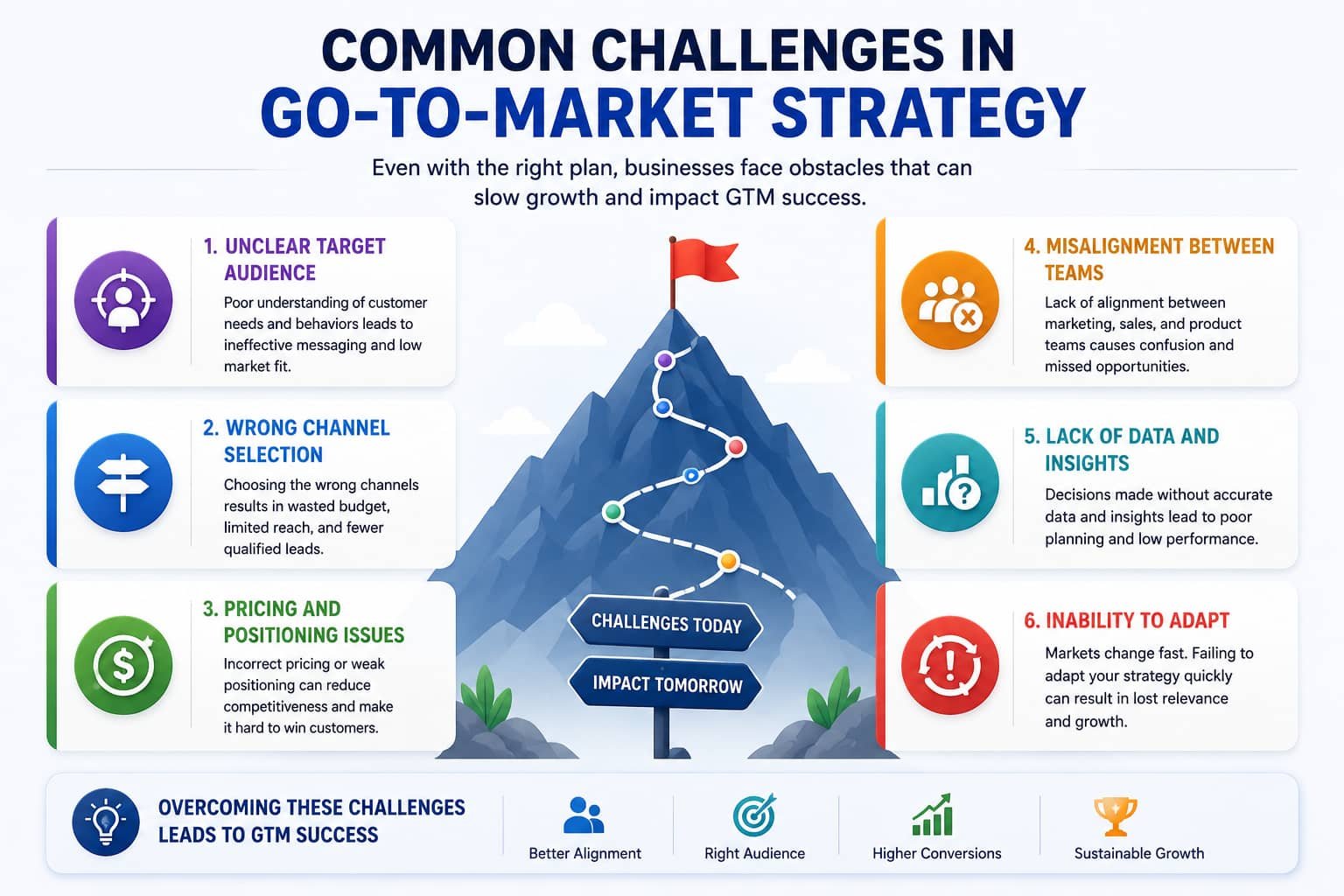
Common Challenges in Go-to-Market Strategy Execution
Even though detailed plans exist, they can still stumble during execution if direction or team alignment is weak. For example, many organizations struggle with customer acquisition not because the product lacks quality, but because messaging and positioning miss the mark with the intended audience.
As a result, poor execution quickly diminishes visibility, slows adoption, and limits growth.
Another frequent obstacle is the disconnect between marketing and sales teams. When departments operate with differing goals or messaging, fragmented customer experiences occur. Consequently, miscommunication often reduces conversions, wastes leads, and undermines performance.
Additionally, channel selection and audience targeting mistakes also plague many initiatives. Ineffective channels inflate costs and deliver weak returns. However, ongoing analysis, customer input, and market testing remain essential for refining the overall approach.
Best Practices for Building an Effective Go-to-Market Strategy
- Define a clear ideal customer profile before launching the product. This understanding of customer pain points, buying behavior, and decision-making patterns helps businesses create more targeted campaigns and stronger messaging.
- Build a strong value proposition that clearly communicates how the product solves a specific problem. Benefit-focused messaging improves customer trust and increases conversion opportunities across channels.
- Align marketing, sales, and customer success teams around shared goals and KPIs. This consistent communication creates a smoother customer journey and improves lead conversion efficiency.
- Use data-driven decision-making to optimize campaigns and customer acquisition strategies. Monitoring key metrics such as CAC, retention rate, and conversion performance helps businesses improve ROI over time.
- Continuously test and refine the GTM strategy based on customer feedback and market trends. Companies that adapt quickly to changing customer expectations are often better positioned for long-term growth and scalability.
The Role of Data and AI in Modern Go-to-Market Strategies
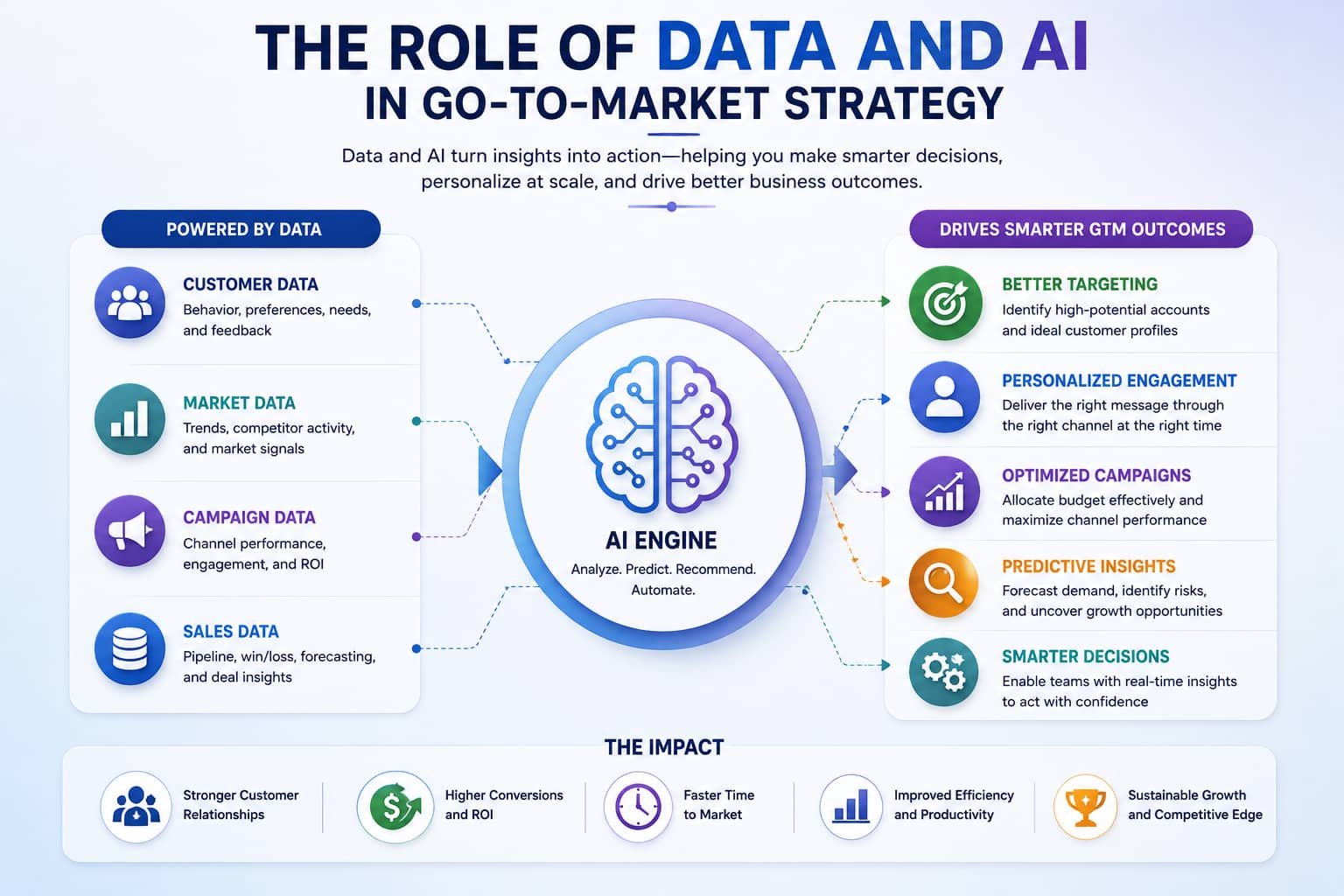
The Role of Data and AI in Modern Go-to-Market Strategy
Nowadays, data and AI play central roles in GTM planning. Specifically, teams use behavioral analytics, predictive modeling, and customer insights to inform decisions at every stage. As a result, these technologies help identify high-value segments, personalize outreach, enhance lead quality, and dynamically optimize messaging.
Moreover, real-time performance tracking adds another layer of strength. With modern platforms, teams can precisely monitor conversions, acquisition costs, engagement, and retention. Consequently, instant visibility allows teams to pivot quickly, boost efficiency, and better match shifting customer expectations.
Driving Long-Term Growth Through a Strong Go-to-Market Strategy
When executed properly, a GTM strategy establishes a strong foundation for sustained expansion. In particular, it unites marketing, sales, product, and customer success around shared objectives. Therefore, companies that prioritize clear positioning, precise targeting, and data-informed choices build stronger market presence.
As customer expectations and market conditions continue to evolve, flexible and measurable GTM frameworks become essential. Through continuous optimization, performance reviews, and fresh research, organizations stay competitive while supporting better retention and profitability. Ultimately, a robust go-to-market approach not only improves launch success but also creates scalable pathways for future growth.